Onward and Upward
Latest Updates | Understanding the Moment | Related Links | Understanding SB 185
Statement on May 21 Court Filing | Statement on May 11 Court Filing
Dr. Akakpo's Messages | Alumni President Remarks | FAQ
*** Share Your Comments, Concerns, and Suggestions ***
Latest Update: CPE Approves Kentucky State Academic Plan
Updated July 10, 2026
The Council on Postsecondary Education’s governing body, at its June 12 meeting, approved Kentucky State University’s academic transformation proposal required under Senate Bill 185. This action follows the Kentucky State University Board of Regents’ May 28 approval of the University’s academic plan and marks another important step in the implementation process.
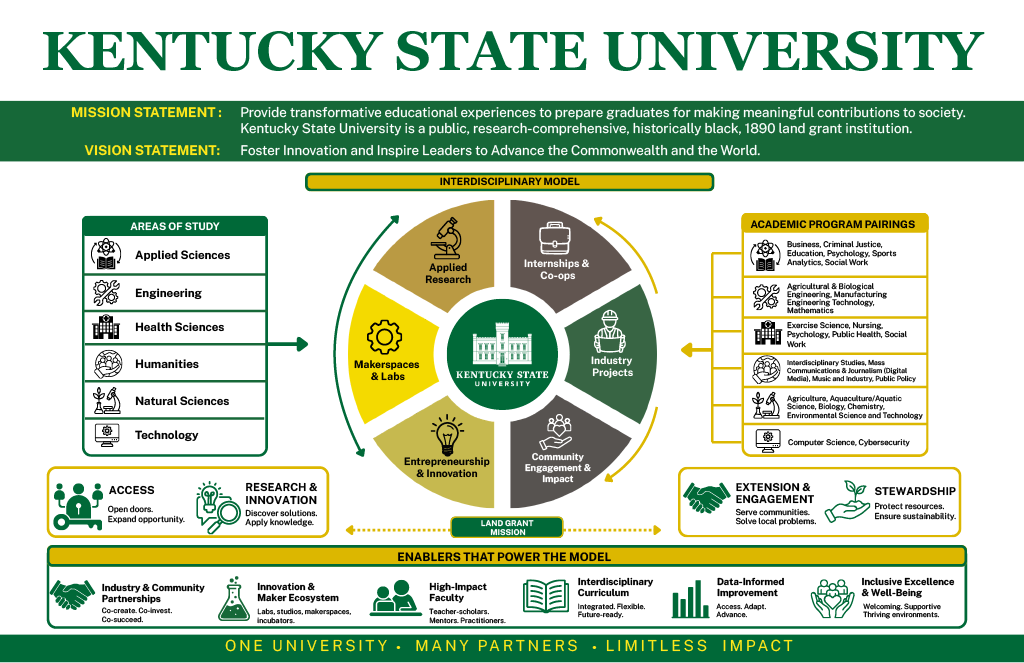
CPE approved six academic areas of study for Kentucky State:
- Applied Sciences
- Engineering
- Health Sciences
- Humanities
- Natural Sciences
- Technology
The majority of Kentucky State’s existing majors already fit within the six approved areas. These areas will help organize the University’s academic portfolio around highly technical, industry-based applied learning aligned with Kentucky’s workforce needs, while preserving Kentucky State’s historic mission as the Commonwealth’s only public HBCU and an 1890 land-grant university.
Under the approved structure, Kentucky State will continue 28 active bachelor’s, master’s, and doctoral degree programs that support the University’s revised mission and long-term academic strategy. Four additional programs are scheduled for implementation beginning in the 2026-27 academic year. The University also offers 38 additional credentials at the associate degree, undergraduate certificate, and post-baccalaureate certificate levels, for a total of 70 credential offerings. The model is intended to strengthen connections across disciplines while expanding applied learning opportunities through research, internships and co-ops, industry projects, labs and makerspaces, entrepreneurship, community engagement, and Extension.
The Council also approved the closure of four undergraduate programs: Music Education, Music Performance, Political Science, and Child Development and Family Studies. Kentucky State will develop teach-out plans for affected students, which must be submitted through the required accreditation process. Students remain central to implementation, and where any program is closed or substantively changed, the University’s responsibility is clear: affected students must have a path to degree completion.
The June 12 CPE action also included approval of a financial obligation and expenditure approval policy for Kentucky State. The policy is intended to streamline approval processes created by SB 185, including the law’s requirement that Kentucky State seek prior CPE approval for expenditures over $20,000.
The same academic planning information was shared with the Kentucky State University Board of Regents during its regularly scheduled summer meeting June 11-12. The Board also approved the FY27 budget and reviewed the organizational realignment necessary to support the University’s next chapter.
Kentucky State will continue to share implementation updates as this work moves forward.
- CPE News Release: CPE approves six areas of study for Kentucky State University (June 12, 2026)
- Council Business Agenda Item: Kentucky State University Response to SB 185 (June 12, 2026)
- President's Message: A Clear View of Our Work Ahead (June 12, 2026)
Board of Regents Action on Academic Plan
Updated May 28, 2026
The Kentucky State University Board of Regents, at a special-called meeting on Thursday, May 28, approved the University’s academic plan required under Senate Bill 185 and authorized its delivery to the Council on Postsecondary Education by June 1. This action marks an important step in the University’s implementation of SB 185, but it is not the end of the process. The plan now moves forward through the next phase of review, planning, and implementation with CPE and other appropriate partners.
The academic plan reflects work already underway at Kentucky State, including academic program review, reorganization of Academic Affairs into three colleges, reduced degree pathway complexity, advising improvements, implementation of DegreeWorks, adoption of a multi-year catalog, and development of new programs connected to student interest and workforce demand. Under the academic plan, programs would be organized around six academic areas of study:
- Applied Sciences
- Engineering
- Health Sciences
- Humanities
- Natural Sciences
- Technology
The majority of Kentucky State’s existing majors already fit within these areas. The model is intended to strengthen connections across disciplines while expanding applied learning opportunities through research, internships and co-ops, industry projects, labs and makerspaces, entrepreneurship, community engagement, and Extension.
The plan also includes proposed program actions that will continue through the CPE process. Those include recommendations related to Childhood Development and Political Science, as well as changes within music-related academic offerings. General Music as well as Music Industry and Technology would remain part of the transition. Anticipated academic program changes would have no impact on Kentucky State’s Concert Choir or Marching Band, both important parts of the University’s history and heritage. Both ensembles continue to actively recruit new and continuing members.
Students remain central to the implementation process. Where any program is proposed for closure or substantive change, the University’s responsibility is clear: affected students must have a path to completion through appropriate teach-out plans or arrangements.
Kentucky State University remains the Commonwealth's only public HBCU and an 1890 land-grant university.
- President’s Message: An Important Step Forward (May 28, 2026)
- University News Release: Board of Regents Advances Kentucky State University Academic Plan Under Senate Bill 185
Understanding the Moment
April 13, 2026
Kentucky State University is at an important and historic moment. With Senate Bill 185 now signed into law, many understandably have questions about what this direction means for Kentucky State’s future. At its core, this is not a departure from who we are. It is an effort to build on the University’s strengths and position it for long-term sustainability, innovation, and service.
Simply put, this kind of academic direction, with its polytechnic emphasis, combines strong academics with hands-on learning, applied research, and career-connected programs that prepare students to solve real-world problems. That broad direction can also be seen across leading HBCUs, where institutions such as Howard University, North Carolina A&T State University, Florida A&M University, Morgan State University, Spelman College, Morehouse College, and Tuskegee University have built strong reputations in STEM, health sciences, research, medicine, and the preparation of future scientific and professional leaders. In the broader higher education landscape, many people also recognize that model through institutions such as MIT, Caltech, and Georgia Tech, where rigorous study is also closely tied to innovation and practical application.
Our repositioning along these lines is part of a much longer history of evolution at Kentucky State. Since our founding in 1886 and our designation as an 1890 land-grant institution just four years later, the University has continued to grow and change in response to the needs of Kentucky. From a normal school, to a land-grant college, to a university, Kentucky State has never stood still. Relevance has always been part of our DNA.
That direction is already visible in longstanding strengths in agriculture, food security, clean water, and other applied areas of public need, as well as growth in STEM, nursing, health science, manufacturing engineering technology, biological and agricultural engineering, aquaculture and aquatic science, sports analytics, geospatial and drone technology, cybersecurity, artificial intelligence, online learning, and other emerging fields. The University’s 2025 Carnegie classification as a Research Colleges and Universities institution, together with its standing as home to Kentucky’s third-largest university research portfolio, underscores that momentum.
Viewed in that context, this direction affirms and sharpens a path already underway. It strengthens the connection among research, academic opportunity, and career preparation while preserving Kentucky State’s historic mission as an HBCU and 1890 land-grant university.
University News Release: A Bold, New Chapter Begins at Kentucky State University
Related links:
- SB 185 - Final Version
- SB 185 - PHS 1 - Processed and Approved
- House Standing Committee on Appropriation and Revenue (video)
- Senate Floor Amendment 1
- 26 RS SB 185 / PSS1
- Senate Appropriation & Revenue Committee introduces SB 185 (video)
- Full legislative information relating to SB 185 on the website for the Kentucky General Assembly and the Kentucky Legislative Research Commission (LRC)
Understanding SB 185
Senate Bill 185 is now law. It redefines Kentucky State University in state statute as Kentucky’s only public HBCU and an 1890 land-grant university, while establishing the University as a four-year residential polytechnic institution focused on highly technical, industry-based applied learning. The law also makes clear that Kentucky State will continue to offer both liberal studies and polytechnic programs aligned with the workforce needs of the Commonwealth and consistent with the historical mission of an HBCU.
The law declares a state of financial exigency at Kentucky State University for five years from its effective date, or until the General Assembly affirmatively declares, based on a recommendation from the Council on Postsecondary Education, that the University’s finances are stable, whichever occurs first. During that period, the University is subject to expanded financial oversight by the Council on Postsecondary Education. Kentucky State may not enter into an obligation or make an expenditure of $20,000 or more without prior CPE approval, and the University must provide monthly financial reports, fully cooperate with CPE oversight, transition all financial transactions to monthly EMARS reporting and reconciliation by July 1, 2027, and avoid incurring a budget deficit during the period of financial exigency.
SB 185 also requires a thorough academic program review. The Kentucky State University Board of Regents, in consultation with the Council on Postsecondary Education, must identify which academic programs the University proposes to maintain and which it recommends for closure or other substantive change, along with corresponding teach-out plans or teach-out arrangements for affected students. Beginning with the 2026-2027 academic year and continuing for five academic years thereafter, Kentucky State may offer no more than 10 academic areas of study, excluding programs that are exclusively online, programs in the College of Education, and programs determined by CPE to be necessary to the University’s mission as a polytechnic institution.
The law also makes significant changes affecting staffing, admissions, and student balances. During the financial exigency period, the president has authority to terminate university employees, including tenured employees in accordance with university policy, upon 30 days’ notice. For undergraduate admission, new applicants must generally meet minimum academic standards, though the law also provides alternative discretionary admission pathways for certain groups of students, including qualifying transfer students, veterans, graduates of nonpublic schools meeting the testing standard, nontraditional-age students with demonstrable professional experience, and dual-credit students.
In addition, the law restricts admission, readmission, enrollment, or continued participation for individuals with an outstanding balance to the University in excess of $1,000 that has been due and owing for more than 60 days. It also clarifies that, for students on an approved payment plan, the full balance is not deemed due unless one or more payments under that plan have been overdue for more than 60 days. Kentucky State must report qualifying debts quarterly to CPE, and debts in excess of $1,000 that have been due and owing for more than 90 days must be referred to the Department of Revenue for collection.
The law does not rename the University. It does, however, replace older statutory language that described Kentucky State as a four-year residential institution emphasizing liberal studies appropriate to its size and resources. It also changes the treatment of Greek life from earlier bill drafts. Under the enacted law, fraternities and sororities currently in good standing maintain their charter recognition, while the Board of Regents may establish policies for periodic review of student organizations consistent with policies at other Kentucky public universities, provided those policies respect freedom of association and apply equally to all student organizations.
Kentucky State University Statement on May 21 Court Filing
Kentucky State University has received notice of the lawsuit filed in Franklin Circuit Court challenging Senate Bill 185 and is reviewing the filing with counsel. Because this is active litigation, the University will not comment on specific legal claims or allegations contained in the complaint.
As with the related filing on May 11, the University was not involved in the filing of the lawsuit, did not coordinate with the individuals who filed it, and was not aware of this second action prior to its filing.
Kentucky State University will continue to follow all applicable laws and work collaboratively with state and federal partners in fulfillment of its mission, which is focused on students, academic quality, public service, and preparing graduates to meet the needs of the communities they serve. This commitment carries particular meaning this week, as Kentucky State University observes the 140th anniversary of its founding on May 18, 1886, and more than a century of continuous service to the Commonwealth as Kentucky’s only public HBCU and an 1890 land-grant institution.
The University has continued building on that legacy through new academic programs in fields including aquatic science, public policy, sports analytics, public health, cybersecurity, manufacturing engineering technology, social work, criminal justice, and biological and agricultural engineering, alongside existing strengths in STEM+H, agriculture, business, education, aquaculture, and applied research.
- Link available at: https://www.kysu.edu/news/2026/5/kentucky-state-university-statement-on-may-21-court-filing-1.php
- Full filing available in this related news story: https://www.wdrb.com/news/education/ksu-students-fil-another-lawsuit-calling-new-state-law-unconstitutional/article_ea474b4e-4d15-4731-af62-0dec24c6e0f5.html
Kentucky State University Statement on May 11 Court Filing
Kentucky State University is aware of the lawsuit filed today involving the Commonwealth of Kentucky and other parties. The University was not involved in the filing of the lawsuit, did not coordinate with the individuals who filed it, and was not aware of the action prior to today. The University is currently reviewing the over 1,000 pages of the filing.
As a public institution, Kentucky State University will continue to follow all applicable laws and work collaboratively with state and federal partners in fulfillment of its mission.
Since 1886, Kentucky State University has proudly served the Commonwealth of Kentucky as a historically Black university and 1890 land-grant institution. As we celebrate 140 years of impact this year, we remain focused on student success, academic excellence, research, public service, and expanding opportunities for the communities we serve.
- Link available at: https://www.kysu.edu/news/2026/5/kentucky-state-university-statement-on-may-11-court-filing.php
- Full filing available in this related news story: https://spectrumnews1.com/ky/louisville/news/2026/05/11/kentucky-state-university-lawsuit
Messages from Dr. Akakpo
- Renewing a Place Generations Have Called Home (July 24, 2026)
- Building Our Future, Preserving Our Legacy (July 16, 2026)
- Applied Research, Community Impact (July 2, 2026)
- Our Responsibility through Change (June 25, 2026)
- Purpose in Motion (June 18, 2026)
- A Clear View of Our Work Ahead (June 12, 2026)
- A Charge to Steward a Historic Investment (June 4, 2026)
- An Important Step Forward (May 28, 2026)
- A 140-Year Charge to Serve (May 21, 2026)
- After Commencement, Our Work Continues (May 14, 2026)
- Commencement Week on The Hill (May 7, 2026)
- Start, Stop, and Grow: Shaping Our Future with Purpose (April 30, 2026)
- SB 185 and Academic Program Review Update (April 24, 2026)
- From Enactment to Implementation (April 16, 2026)
- Advocacy, Clarity, and the Road Ahead (April 9, 2026)
- Senate Bill 185 Passes General Assembly and Advances to Gov. Beshear (April 1, 2026)
- Senate Bill 185 Legislative Update (April 1, 2026)
- A Historic Moment in Our Ongoing Evolution (March 26, 2026)
- Kentucky State University Announces Transformational Partnership with the General Assembly and CPE to Strengthen the Future of the Institution (March 25, 2026)
- Read all of Dr. Akakpo's President's Messages
Remarks by Barry C. Johnson, Jr.
President, Kentucky State University National Alumni Association
The following remarks were delivered by Barry C. Johnson, Jr. on April 1, 2026, during legislative consideration of amended Senate Bill 185. // House Standing Committee on Appropriation and Revenue (34:45-39:55)
Good morning. On behalf of the Kentucky State University National Alumni Association, I am Barry Johnson, representing many thousands of proud Thoroughbreds across the Commonwealth, the nation, and globally. It is my distinct honor to appear before this distinguished body today.
Let me begin by thanking the General Assembly collectively, and Republicans and Democrats alike. To Senator McDaniel, Chair Petri, Representative Bray, and the A&R Committee: Thank you for the leadership you provide. Your stewardship of the Commonwealth’s resources is not taken lightly, and I acknowledge the work you do on behalf of all Kentuckians, including myself, which I am a Kentuckian.
To Senator Neal, Senator Givens, House Minority Leader Stevenson, Representative Brown, Representative Hancock, and House Minority Whip Watkins: We are grateful for your presence, your advocacy, and your commitment to the students of Kentucky State University — current and future.
We also wish to extend our appreciation and thanks to Dr. Aaron Thompson, president of the Council on Postsecondary Education, and his entire team. His vision for a stronger, more inclusive postsecondary system lifts up all Kentucky colleges and universities, and we are grateful for his partnership with KSU.
To University President Dr. Kofi Akakpo and his dedicated team: We say thank you. KSU is charting a bold course forward, one rooted in academic excellence and an unshakable commitment to student success. I want to extend our heartfelt gratitude to Kelly Cunningham, Andrea Houston, Cassandra Gray, and their respective teams; the KSU students; and the National Alumni Association leadership team.
And finally, to every KSU alum, every friend of Kentucky State University, and those whose names we know and those whose names we do not, thank you. I took the time to thank and acknowledge all of those because we are all here today because of your collaborative spirit and partnership with KSU.
We believe in the future of KSU. KSU is primed for success. KSU is more than an institution — it is a promise. A promise founded in 1886, KSU has stood for more than a century, a beacon of educational opportunity. Our alumni are teachers, nurses, engineers, public servants, community leaders. We live and work in every county in the state.
When you invest in Kentucky State University, you invest in Kentucky itself; in the communities that need it most; in the students who have the most to gain; and the future of our Commonwealth is working so hard to build.
We are here today with hope grounded in the belief that when Kentucky State leaders and institutions work together, the Commonwealth rises. This amended legislation will not only solidify and propel Kentucky State fully into the future, it will forever retain and preserve its historical mission that has defined this institution for nearly 140 years.
KSU’s mission is not merely historical; it is essential. Essential to this Commonwealth. This legislation honors that legacy while empowering KSU to meet the demands of tomorrow.
So in closing, let this moment also stand as a testament to what true collaboration, genuine partnership can produce when legislators, university leaders, students, community advocates, alumni, and friends come together around a shared purpose. Great things become possible.
What we see in this amended legislation is not the work of any one person or any one office. It is the fruit of collective will, mutual respect, and a common love for KSU, this Commonwealth, and its people. May it serve as a model for what we can accomplish together.
For all of these reasons, I’m asking you to vote "yes" for this legislation in front of you today, and I look forward to building our collective partnership in the future. Onward and upward, and God bless. Thank you for your time.
FAQ - Frequently Asked Questions
*** Share your comments, concerns, and suggestions by clinking here. ***
What did CPE do on June 12?
At its June 12 meeting, the Council on Postsecondary Education approved Kentucky State
University’s academic transformation proposal required under Senate Bill 185. The
approved structure organizes the University’s academic portfolio around six areas
of study: Applied Sciences, Engineering, Health Sciences, Humanities, Natural Sciences,
and Technology.
Does the CPE action mean the process is finished?
No. The June 12 CPE action is an important step, but implementation will continue.
Kentucky State will continue work related to academic organization, student support,
teach-out planning where required, financial oversight, and other responsibilities
under SB 185.
What programs were approved to continue?
Under the approved structure, Kentucky State will continue 28 academic programs that
support the University’s revised mission and long-term academic strategy. These programs
are organized within the six approved areas of study and aligned with the University’s
role as a four-year residential polytechnic institution, the Commonwealth’s only public
HBCU, and an 1890 land-grant university.
Which programs are closing?
CPE approved the closure of four undergraduate programs: Music Education, Music Performance,
Political Science, and Child Development and Family Studies. Kentucky State will develop
teach-out plans for affected students, which must be submitted through the required
accreditation process.
What happens to current students in programs approved for closure?
Affected students will have a path to degree completion through appropriate teach-out
plans or arrangements. Kentucky State will communicate with students as implementation
continues and provide support through the required process.
What does SB 185 do overall?
SB 185 redefines Kentucky State University in state law as the Commonwealth’s only
public HBCU and an 1890 land-grant university, while establishing the University as
a four-year residential polytechnic institution focused on highly technical, industry-based
applied learning. The law also places Kentucky State under expanded financial oversight,
requires an academic program review, and makes changes related to admissions, student
balances, and other institutional operations.
Has Senate Bill 185 become law?
Yes. Senate Bill 185 was signed into law on April 13, and the 2026 legislative session
has ended.
What did the Board of Regents do on May 28?
The Kentucky State University Board of Regents, at a special-called meeting on Thursday,
May 28, approved the University’s academic plan required under SB 185 and authorized
its delivery to the Council on Postsecondary Education by June 1.
Does the Board action mean the process is finished?
No. The Board action is an important step, but it is not the end of the process. The
academic plan now moves into the next phase of review, planning, and implementation
with CPE and other appropriate partners.
What are the six academic areas of study in the plan?
Under the academic plan, programs would be organized around six academic areas of
study: Applied Sciences, Engineering, Health Sciences, Humanities, Natural Sciences,
and Technology. The majority of Kentucky State’s existing majors already fit within
these areas.
Is it true that Kentucky State will be limited to only 10 majors?
No. The law does not say “10 majors.” It says Kentucky State may offer no more than
10 academic areas of study for five academic years beginning in 2026-2027, with exceptions
for programs offered exclusively online, programs in the College of Education, and
programs CPE determines are necessary to the University’s mission as a polytechnic-focused
university.
Will Kentucky State’s academic offerings change?
Yes, some academic offerings may change as part of the required review process. The
academic plan includes proposed program actions that will continue through the CPE
process, with teach-out plans or teach-out arrangements for affected students.
Which programs are included in proposed changes?
The academic plan includes recommendations related to Childhood Development and Political
Science, as well as changes within music-related academic offerings. General Music
as well as Music Industry and Technology would remain part of the transition.
Does this mean Concert Choir or Marching Band will be eliminated?
No. Anticipated academic program changes would have no impact on Kentucky State’s
Concert Choir or Marching Band, both important parts of the University’s history and
heritage. Both ensembles continue to actively recruit new and continuing members.
Will liberal arts or humanities disappear?
No. Humanities is one of the six academic areas of study included in the academic
plan. The law also states that Kentucky State will offer both liberal studies and
polytechnic programs aligned with workforce needs and consistent with the historical
mission of an HBCU. The humanities and interdisciplinary studies remain important
to developing skills such as critical thinking, communication, creativity, problem-solving,
professionalism, and adaptability.
What happens to current students if a program is changed, moved online, or discontinued?
Would they have to transfer?
No student will be left without a path to degree completion at Kentucky State University.
The law requires teach-out plans or teach-out arrangements for programs recommended
for closure or other substantive change, and those plans must go through the required
review and approval process. Students will have time, communication, and support throughout
that process.
Did the law change Kentucky State University’s name?
No. Kentucky State University remains Kentucky State University. The law changes how
the University is defined in statute, but it does not rename the institution.
Will Kentucky State still remain an HBCU and an 1890 land-grant university?
Yes. The law explicitly recognizes Kentucky State as Kentucky’s only public HBCU and
an 1890 land-grant university. That does not change.
Is this a break from Kentucky State’s identity and history?
No. The law establishes a new academic direction, but it also expressly ties that
direction to Kentucky State’s historic mission as an HBCU. The University’s identity,
legacy, and public mission remain central.
Why this academic direction now?
In many ways, Kentucky State has already been moving in this direction. The University
has grown in areas such as STEM, nursing, health sciences, engineering pathways, agriculture,
aquaculture, cybersecurity, geospatial and drone technology, artificial intelligence,
and other applied fields. The law formalizes and sharpens a direction that builds
on those strengths while connecting academic programs more closely to workforce needs
in the Commonwealth.
Will Kentucky State expand online offerings?
Online programs remain an important part of the University’s future. Under SB 185,
programs offered exclusively online are excluded from the limit on academic areas
of study, which gives Kentucky State flexibility as it reviews and structures its
academic offerings.
Will education and teacher preparation continue?
Yes. Programs in the College of Education are explicitly excluded from the limit on
academic areas of study.
Is enrollment limited to 1,000 students?
No. The law refers to an enrollment target of at least 1,000 in-person students. It
does not establish a fixed cap of 1,000 students overall.
Will students enrolled in non-polytechnic programs still be able to live on campus?
Yes. Students currently in in-person courses and approved for housing may remain in
housing as long as they meet University requirements. Kentucky State currently requires
full-time first-year and sophomore students to live on campus, with certain exceptions,
and that expectation will continue for in-person students.
If a current in-person program is later moved online, students already enrolled in that program will still be able to live on campus through completion of their degree during the five-year teach-out period as long as they meet other requirements.
Are athletics being canceled?
No. Athletics remain a vital part of campus life. Kentucky State competes at the NCAA
Division II level in the Southern Intercollegiate Athletic Conference, and nothing
in SB 185 eliminates athletics.
Will Greek life be banned from campus?
No. Under the enacted law, fraternities and sororities currently in good standing
maintain their charter recognition. The Board of Regents may establish policies for
periodic review of student organizations, but those policies must be consistent with
policies at other Kentucky public universities, respect freedom of association, and
apply equally to all student organizations.
Will the law change admissions requirements?
Yes. New undergraduate applicants generally must have a cumulative unweighted high
school GPA of at least 2.5 and a composite ACT score of at least 18, or an equivalent
score on the SAT or another nationally recognized college-readiness examination approved
by CPE.
The law also allows alternative discretionary admission pathways for certain groups, including qualifying transfer students, veterans, certain graduates of nonpublic schools, nontraditional-age students with demonstrable professional experience, and dual-credit students.
Will unpaid balances affect enrollment?
Yes. Individuals with an outstanding balance to the University in excess of $1,000
that has been due and owing for more than 60 days may not be admitted, readmitted,
enrolled, or allowed to continue in a course, seminar, or program. For students on
an approved payment plan, however, the full balance is not deemed due unless one or
more payments under the plan have been overdue for more than 60 days.
Will the law change how University spending is approved?
Yes. Kentucky State may not enter into an obligation or make an expenditure of $20,000
or more without prior approval of the Council on Postsecondary Education.
Will unpaid debts be referred for collection?
Yes. Debts in excess of $1,000 that have been due and owing for more than 90 days
must be referred to the Department of Revenue for collection.
Does accreditation still matter under the law?
Yes. SB 185 states that Kentucky State must abide by all instructions provided by
SACSCOC that are required to maintain institutional accreditation.
What new funding opportunities are tied to this law?
Related budget action includes as much as $105 million in General Assembly appropriations:
$50 million for a Health Sciences Center, $50 million for asset preservation, $2 million
for expanded online learning, and $3 million for polytechnic transition support. This
represents the largest state appropriation in Kentucky State University’s history.
What is the proposed Health Sciences Center opportunity?
The broader legislative and budget action includes a $50 million investment in a new
59,000-square-foot Health Sciences Center. The facility would expand training capacity
in nursing, respiratory therapy, public health, and related disciplines, with simulation
labs, classrooms, research laboratories, and clinic space to support community-facing
public health services.
Updated June 12, 2026