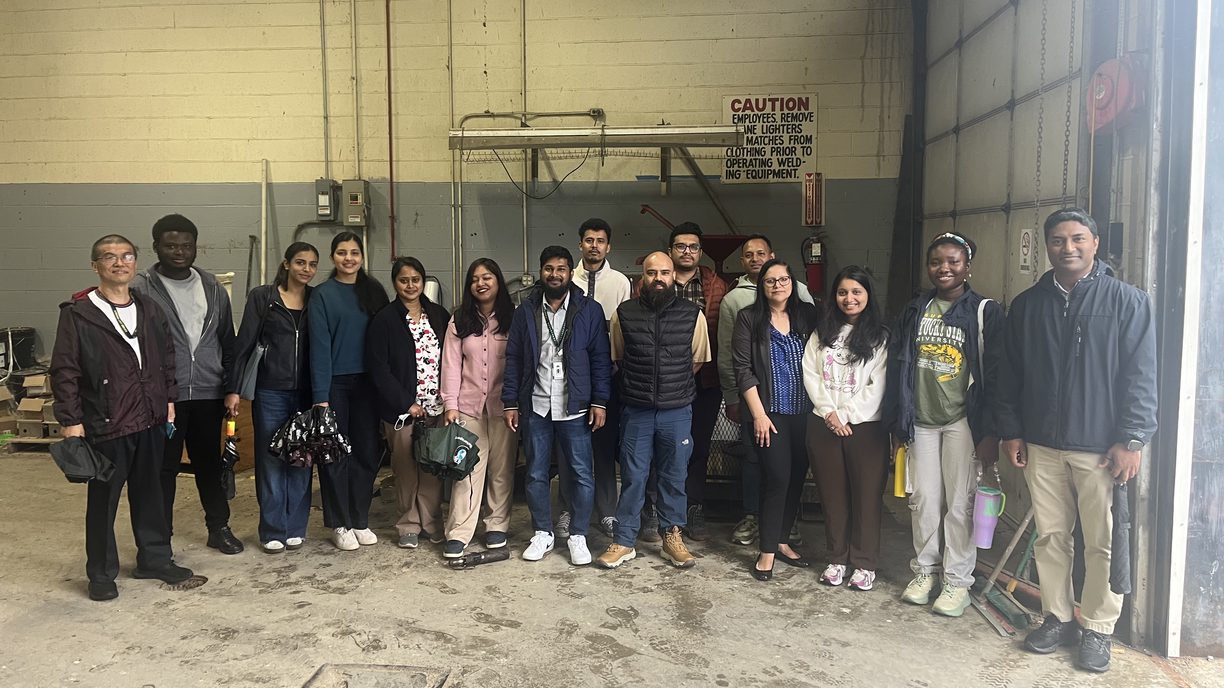
School of Engineering and Technology students toured Frankfort wastewater facilities,
connecting BAE coursework in water quality, hydrology, and environmental engineering
to public infrastructure
FRANKFORT, Ky. — On a rainy Friday morning at the Frankfort Wastewater Treatment Plant,
Kentucky State University students saw how classroom lessons in water quality, hydrology,
and environmental engineering translate into public infrastructure.
The May 22 field visit was organized by Dr. Milon Chowdhury, assistant professor of agricultural and biological engineering; Dr. Liang Yu, assistant professor and graduate coordinator for the Biological and Agricultural Engineering program; and Dr. Jyotica Batra, chair of the School of Engineering and Technology.
Together, the faculty members brought academic expertise spanning agricultural engineering, biological and agricultural engineering, sustainable water reuse, organic waste management, environmental systems, and applied science. That range helped students connect the technical work of wastewater treatment to broader questions of infrastructure, water resources, environmental protection, and community service.
 Kenny Hogsten, director of the Frankfort Sewer Department, and Carl Groce, plant superintendent,
guided students through the facility and related infrastructure. The visit included
wastewater treatment units, Environmental Facilities Improvement (EFI) construction
sites, and the newly developed Paddocks Pump Station.
Kenny Hogsten, director of the Frankfort Sewer Department, and Carl Groce, plant superintendent,
guided students through the facility and related infrastructure. The visit included
wastewater treatment units, Environmental Facilities Improvement (EFI) construction
sites, and the newly developed Paddocks Pump Station.
Each stop gave students a closer look at how a sanitary sewer system works, from collection
and pumping to treatment and discharge.
Many of the students had recently completed courses including BAE 569 Water Quality
Engineering and BAE 572 Small Watershed Hydrology. The field visit extended that coursework
by allowing students to observe engineering principles, system design, and operational
decision-making in a working facility.
“This type of experiential learning is critical for student success,” Dr. Batra said. “Seeing how wastewater systems function, especially under real operational conditions, strengthens students’ understanding and prepares them for professional roles in the field.”
Rain added a practical lesson of its own.
Steady rainfall throughout the morning, at times heavy, gave students a real-time view of the challenges wastewater systems can face during wet-weather conditions. Increased stormwater inflow can place additional pressure on infrastructure, affect treatment processes, and require careful management to maintain system efficiency.
 Dr. Yu said the conditions reinforced the connection between hydrology and wastewater
engineering, showing how natural environmental factors influence system design, operations,
and long-term infrastructure planning.
Dr. Yu said the conditions reinforced the connection between hydrology and wastewater
engineering, showing how natural environmental factors influence system design, operations,
and long-term infrastructure planning.
The experience also underscored the role of wastewater treatment and sanitary sewer systems in protecting public health, supporting communities, and managing water resources responsibly.
For students preparing for careers in engineering, environmental science, water resources, and related fields, the visit offered a direct look at the technical and operational complexity behind services many people depend on every day.
The field trip reflects Kentucky State’s commitment to hands-on learning and workforce development in engineering and environmental sciences. Through partnerships with regional utilities such as the Frankfort Sewer Department, students gain practical experience while engaging with professionals responsible for maintaining essential public infrastructure.
By connecting academic preparation with real-world facilities, the University continues to prepare graduates equipped to address current and future challenges in water resources, environmental protection, and sustainable engineering.