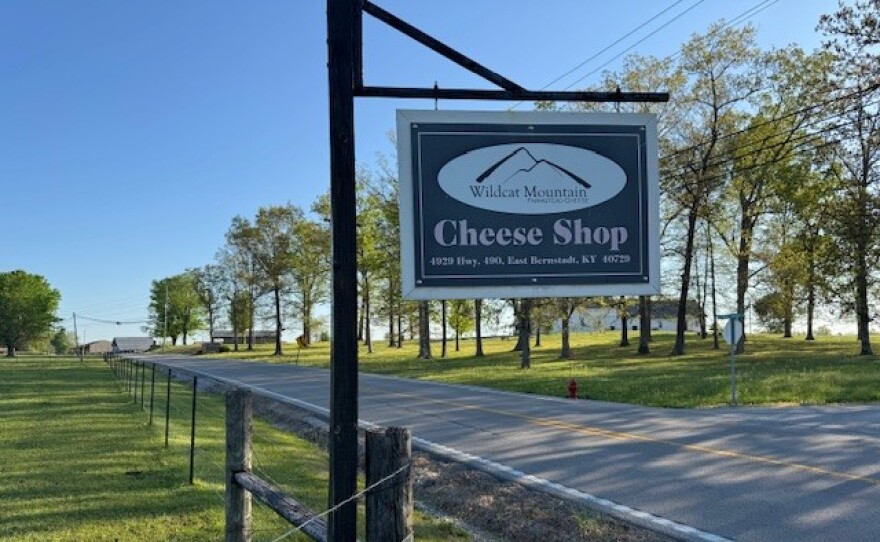
WEKU feature on Wildcat Mountain Cheese includes insight from Kentucky State University’s
Laura Rogers on the challenges facing small farmers
FRANKFORT, Ky. — A recent WEKU feature on Wildcat Mountain Cheese in Laurel County
offered more than a glimpse inside a family-run dairy and cheesemaking operation.
It also underscored the importance of Kentucky State University Cooperative Extension
in supporting small farmers across the Commonwealth.
 The story, part of WEKU’s “Off the Beaten Path with Sam Dick,” profiles Ronnie and
Clara Patton of Wildcat Mountain Cheese in East Bernstadt. Ronnie Patton is a third-generation
dairy farmer who milks 20 cows twice a day, seven days a week, while Clara Patton
turns the farm’s milk into more than a dozen varieties of cheese sold from the farm
shop, at farmers markets, and through small retailers from Kentucky to West Virginia.
The story, part of WEKU’s “Off the Beaten Path with Sam Dick,” profiles Ronnie and
Clara Patton of Wildcat Mountain Cheese in East Bernstadt. Ronnie Patton is a third-generation
dairy farmer who milks 20 cows twice a day, seven days a week, while Clara Patton
turns the farm’s milk into more than a dozen varieties of cheese sold from the farm
shop, at farmers markets, and through small retailers from Kentucky to West Virginia.
The feature also includes perspective from Laura Rogers, small farm area agent with
Kentucky State Cooperative Extension, who spoke to the challenges facing small farms
as fewer young people pursue agriculture as a livelihood.
“One thing is that our population is getting older,” Rogers told WEKU. “I don’t see
as many 18, 19, 20-somethings doing it. It’s hard work.”
For Kentucky State, the story reflects the purpose of Cooperative Extension: connecting
research-based knowledge, practical support, and local relationships to the farmers,
families, and communities working to sustain agriculture in Kentucky.
That support also includes programs such as Kentucky State’s Small-Scale Farm Grant, which helps Kentucky small-scale farmers strengthen their operations. Since the
program’s inception in December 2012, the Kentucky Office of Agricultural Policy has
provided $7.7 million in program funding, which Kentucky State administers through
grant cycles. To date, the University has distributed more than $5.5 million to support
1,642 funded projects in 116 counties across the Commonwealth. Kentucky State continues
working to distribute remaining funds and extend the program’s reach to all Kentucky
counties.
The Small-Scale Farm Grant frequently helps farmers sustain their businesses or pursue
new directions that otherwise may not be possible. For many producers, modest investments
in equipment, infrastructure, and farm needs can make a significant difference in
long-term viability.
 “Small farms remain essential to Kentucky’s agricultural identity and rural economy,”
Rogers said. “Families like the Pattons show the commitment, skill, and discipline
it takes to keep these operations going. Our role through Cooperative Extension is
to meet producers where they are, listen to their needs, and help connect them with
information and resources that can strengthen their farms.”
“Small farms remain essential to Kentucky’s agricultural identity and rural economy,”
Rogers said. “Families like the Pattons show the commitment, skill, and discipline
it takes to keep these operations going. Our role through Cooperative Extension is
to meet producers where they are, listen to their needs, and help connect them with
information and resources that can strengthen their farms.”
Wildcat Mountain Cheese combines traditional farming with value-added agriculture,
a model that allows producers to create new market opportunities from what they raise
or grow. In the Pattons’ case, milk from their dairy cows becomes cheese made on site
in a sanitized production space, where food science, experience, and long workdays
come together.
That kind of entrepreneurship is increasingly important for small producers seeking
to remain viable in a changing agricultural landscape.
“Kentucky State’s 1890 land-grant mission is rooted in service,” said Dr. Marcus Bernard,
dean of the College of Agriculture, Health, and Natural Resources and director of
Land-Grant Programs. “Our Cooperative Extension professionals work directly with producers
across the Commonwealth, including small and family farms. This story is a reminder
that the future of agriculture depends not only on innovation, but also on relationships,
trust, and sustained support for the people doing the work every day.”
Through Cooperative Extension, Kentucky State provides education and outreach in areas
such as small farm development, value-added agriculture, livestock, horticulture,
aquaculture, food safety, family and consumer sciences, youth development, and community
resource development.
For Rogers, the WEKU feature highlights both the challenge and the opportunity.
“When people see the work behind a product like farmstead cheese, they begin to understand
the depth of knowledge and dedication that small farmers bring to their communities,”
Rogers said. “Those stories matter because they help consumers connect with local
agriculture and help the next generation see that farming still has a future.”
The full WEKU feature, “Wildcat Mountain Farmstead Cheese,” is available from WEKU.