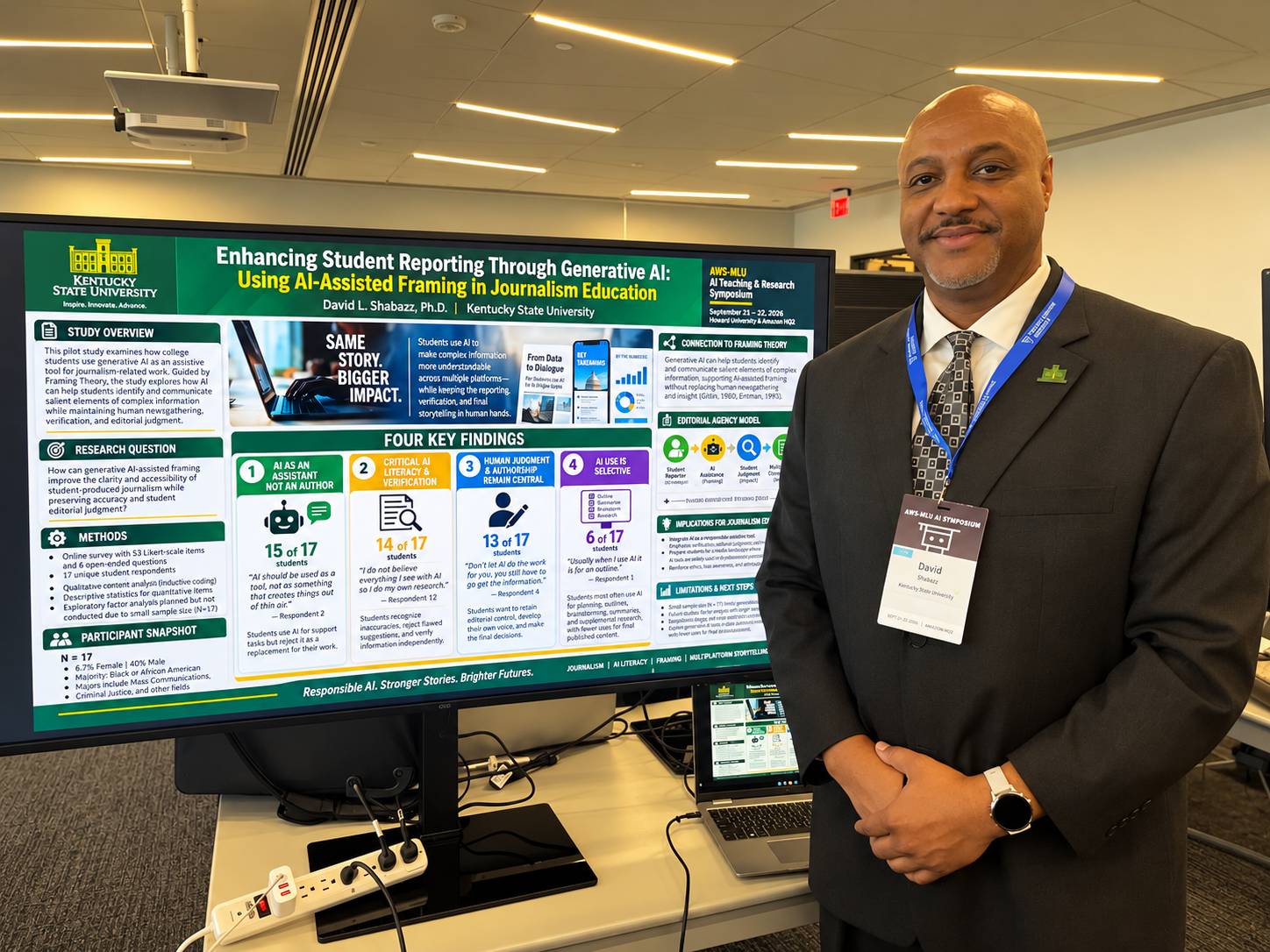
Dr. David L. Shabazz shared findings at an Amazon Web Services teaching and research symposium in Arlington, Virginia
FRANKFORT, Ky. — Students using artificial intelligence for journalism tasks place a high value on verification, human judgment, and authorship, according to a preliminary qualitative case study by a Kentucky State University professor.
Dr. David L. Shabazz, associate professor of journalism, presented his research Sept. 22 during the Amazon Web Services Machine Learning University AI Teaching & Research Symposium at Amazon’s HQ2 in Arlington, Virginia.
His study, “Enhancing Student Reporting Through Generative AI: Using AI-Assisted Framing in Journalism Education,” explored the experiences and perspectives of 17 college students using generative AI for tasks including identifying potential news sources, organizing information, evaluating accuracy, and creating multimedia content.
Within that group, 15 participants described AI as an assistant rather than an author. Fourteen emphasized the importance of critically evaluating and verifying AI-generated information, and 13 stressed that human judgment and authorship must remain central to reporting.
These responses offer insight into how the participants understand their responsibilities as they incorporate new tools into their work. Their emphasis on verification and authorship accompanied their recognition of AI’s potential to assist with reporting.
“Our students are embracing AI technology because they recognize its potential to strengthen their newsgathering abilities,” Dr. Shabazz said. “It can help them identify a wider range of relevant sources, explore different perspectives, and develop stories that are richer in detail. But it also challenges them to become their own editors by critically evaluating the information they receive, checking the credibility of sources, and making informed editorial decisions.”
The study drew on framing theory, which examines how the selection, organization, and presentation of information shape audience understanding. Dr. Shabazz explored how AI-assisted framing might help students identify important elements of complex information and communicate them through stories across multiple platforms.
That work also considers how students can adapt their reporting to serve audiences who receive news through different formats.
“Journalism is no longer limited to producing a written article,” Dr. Shabazz said. “Students must understand how to communicate across multiple platforms. AI can help them organize complex information and develop multimedia content that makes news easier for readers and viewers to understand and consume. That is especially important in today’s rapidly changing media environment.”
The research identified challenges, including inaccurate information, unreliable sources, and excessive dependence on automated tools. Dr. Shabazz said the preliminary qualitative findings provide a foundation for further research into AI literacy and journalism education.
Dr. Shabazz’s research reflects Kentucky State’s emphasis on innovation-driven education, connecting strong academics with hands-on learning, applied research, and career preparation. That direction builds on the University’s mission as Kentucky’s only public HBCU and an 1890 land-grant institution.
“Journalism has always adapted to technological change, from the printing press to radio, television, and digital media,” Dr. Shabazz said. “Artificial intelligence represents another important transition. Kentucky State’s emphasis on innovation and hands-on learning gives us an opportunity to prepare students to understand these tools and apply them responsibly in professional settings.”
Dr. Shannon Brogan, acting chair of the School of Humanities, said the research illustrates how emerging technology can be integrated with the critical thinking and ethical preparation students need in professional settings.
“This work reflects the important role that the humanities can play in preparing students to use technology thoughtfully, creatively, and responsibly,” Dr. Brogan said.
Following the symposium, Dr. Shabazz enrolled in a free, six-part AI training series offered through an Amazon Web Services Skills Center. He completed the first session, “Becoming an AI Practitioner: Introduction to AI,” Oct. 6.
He plans to continue examining how AI-assisted reporting can support students’ research, writing, verification, and multimedia storytelling skills.
“The technology can assist with the reporting process, but students must remain responsible for the final product,” Dr. Shabazz said. “AI should never replace the reporter’s judgment, curiosity, or responsibility to the public.”