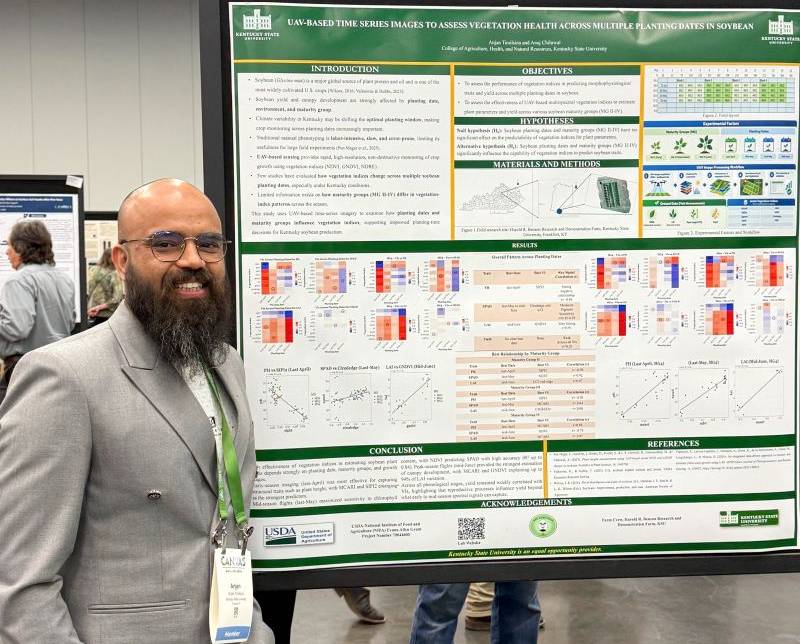
Anjan Timilsina places third in international scientific competition for research exploring how aerial imaging can improve soybean monitoring
Farmers making decisions about when to plant soybeans may soon have another tool to help them understand how their crops are performing: drones equipped with imaging technology that can detect changes not visible to the human eye.
That possibility is driving research by Kentucky State University graduate student Anjan Timilsina, whose work recently earned third place in a master's student poster competition at CANVAS 2026, an international gathering of agricultural scientists in Portland, Oregon.
The conference brought together members of the American Society of Agronomy, Crop Science Society of America, and Soil Science Society of America. Timilsina received the recognition during the "Global Climate and Agricultural Innovation Poster: Research and Solution" session.
His award-winning research, titled "UAV-Based Time Series Images to Assess Vegetation Health Across Multiple Planting Dates in Soybean," examines how drone imagery can help researchers evaluate soybean development under different planting schedules and growing conditions.
Conducted under the supervision of Dr. Anuj Chiluwal, assistant professor of agronomy at Kentucky State, the study addresses a practical challenge in agriculture: understanding how planting dates, soybean maturity groups, and environmental conditions influence crop growth and productivity.
At the University's Harold R. Benson Research and Demonstration Farm, researchers studied three soybean maturity groups planted on five different dates. The team combined traditional field measurements with multispectral drone imagery, which captures wavelengths of light beyond those visible to the human eye, to assess vegetation health and development.
By comparing aerial images with measurements of plant growth, physiological characteristics, and grain yield, the researchers explored whether drones could provide a faster, less labor-intensive way to monitor crop conditions without disturbing the plants.
"This experience provided a valuable opportunity to present my research, exchange
ideas with other researchers, and receive constructive feedback," Timilsina said.
"Earning third place makes this experience especially meaningful. I am very grateful
for the mentorship and continuous support of my advisor, farm staff, and the research
environment at Kentucky State University."
Dr. Chiluwal said the recognition reflects both Timilsina's accomplishments and the
potential of emerging technologies to advance agricultural research.
"His work demonstrates how drone-based monitoring can improve the assessment of soybean growth while highlighting areas where additional measurements are needed to better understand crop performance under varying environmental conditions," Dr. Chiluwal said.
For Kentucky State, the project illustrates how graduate research can connect emerging technologies with the practical needs of agriculture. Developing more efficient ways to assess crop health could ultimately help researchers and producers make better-informed decisions about planting strategies and crop management.
The study was supported by the U.S. Department of Agriculture's National Institute of Food and Agriculture through the Evans-Allen Research Program, Accession No. 7004460.