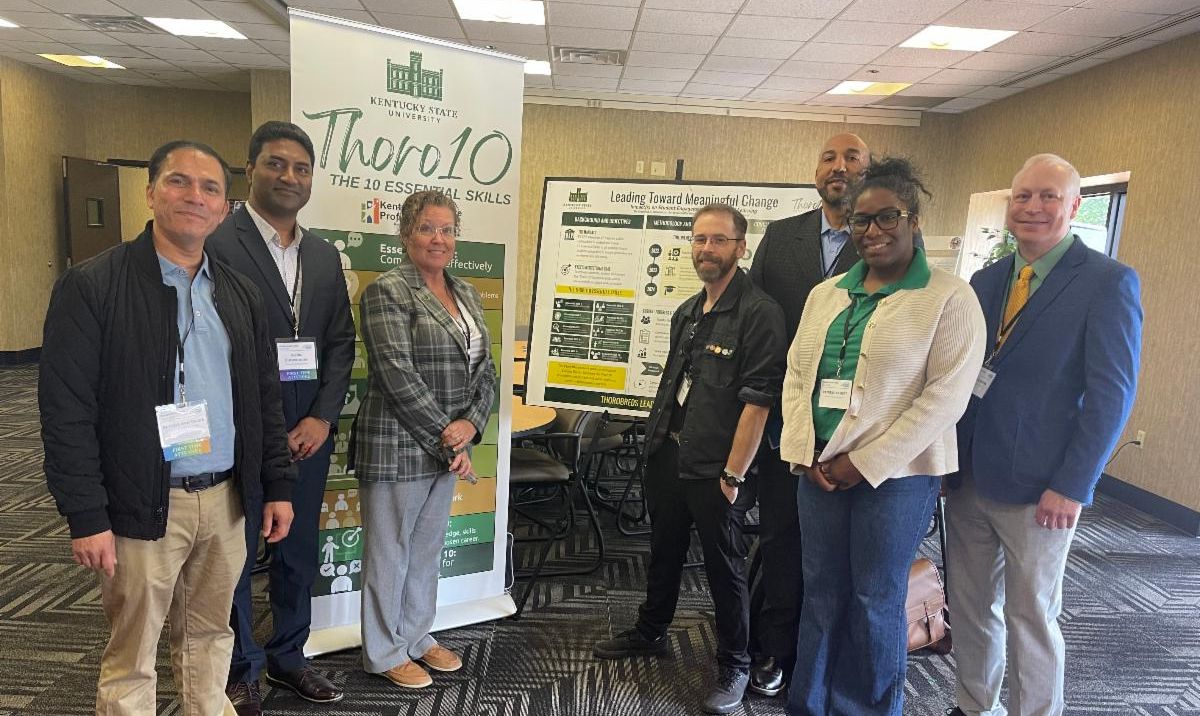
Faculty members shared how Kentucky State is embedding essential skills into curriculum,
assessment, and student career readiness.
FRANKFORT, Ky. — Kentucky State University faculty helped bring Thoro10 into a statewide
conversation on how colleges can connect classroom learning, student engagement, and
workforce preparation.
The University’s work was highlighted during the Graduate Profile Institute and Pedagogicon
2026, statewide gatherings focused on teaching innovation, assessment, artificial
intelligence, high-impact practices, and the future of student learning.
Kentucky State’s participation centered on Thoro10, the University’s framework for
embedding Kentucky’s 10 Essential Skills across undergraduate education. The effort
helps students build and demonstrate skills such as communication, critical thinking,
teamwork, professionalism, adaptability, and applied problem-solving.
That work has advanced under the leadership of Dr. Frederick A. Williams Jr., Kentucky
Graduate Profile Academy Team Lead. Dr. Williams was recently appointed Interim Dean
of the College of Arts and Sciences after serving several years as chair of the School
of Criminal Justice and Government Relations.
For Pedagogicon, Dr. Williams developed the poster presentation “Leading Toward Meaningful
Change: Impact(s) on Student Engagement & Exceptional Learning,” which highlighted
Kentucky State’s multi-year approach to Thoro10 implementation. Dr. Williams joined
Mr. Bruce Griffis and Dr. Tierra Freeman-Taylor in representing the University’s Thoro10
work at the statewide gathering.
Dr. Freeman-Taylor played a central role in Kentucky State’s Pedagogicon presence,
serving as a featured panel participant and presenter. In that role, she shared insight
into the University’s approach to academic assessment and helped elevate Kentucky
State’s work before colleagues from across the Commonwealth.
The poster presentation outlined efforts that include leadership workshops, revision
of the 30-hour general education core, designation of the skills as part of the University’s
Quality Enhancement Plan, faculty champion training, curriculum mapping, hallmark
assignments, standardized rubrics, and syllabus integration.
It also showed how Kentucky State is building assessment into the student experience
at multiple levels, from 100-level benchmark courses to 200- and 300-level milestone
experiences and 400-level capstone work. That structure is designed to help faculty
assess student growth over time while giving students clearer opportunities to practice
and demonstrate essential skills.
During the gathering, Dr. Williams was acknowledged alongside other institutional
leaders advancing Kentucky Graduate Profile work across the Commonwealth. Dr. Freeman-Taylor’s
panel presentation further demonstrated Kentucky State’s growing role in statewide
conversations about assessment, student learning, and workforce preparation.
Kentucky State’s participation also reflected broader faculty engagement across the
University. Faculty members who attended the Graduate Profile Institute, Pedagogicon,
or both included Gary Cornett, instructor of communications in the School of Humanities;
Dr. Patrese Nesbitt, assistant professor of health, physical education, and exercise
and sports studies in the School of Education; Dr. Dharma Khatiwada, assistant professor
of physics, in the School of Engineering and Technology; Dr. Carole Cobb, chair of
the School of Education; and Dr. Milon Chowdhury, assistant professor of agricultural
and biological engineering in the College of Business, Engineering, and Technology.
Earlier this spring, the University released the second in a series of Thoro10 videos that helped explain how the framework supports career readiness and how essential
skills are developed across academic programs and campus life.
Together, the video, faculty training, assessment work, panel participation, and statewide
presentation show how Kentucky State is building a common language around student
success. Through Thoro10, the University is helping ensure that Thorobreds graduate
not only with academic knowledge but also the essential skills needed to lead, serve,
adapt, and contribute in a changing world.