Kentucky State University student wins 2026 KentuckyView Undergraduate Fellowship
for geospatial research inspired by USDA NextGen experiential learning in Peru
FRANKFORT, Ky. — A Kentucky State University student who studied terraced agricultural
landscapes in Peru is now applying those lessons to a Kentucky question: Could farming
practices used for centuries in the Andes help Eastern Kentucky farmers adapt to drought,
flooding, and erosion?
Sienna Stewart, an Agriculture, Food, and Environment major and USDA NextGen scholar,
has been selected for the highly competitive 2026 KentuckyView Undergraduate Fellowship.
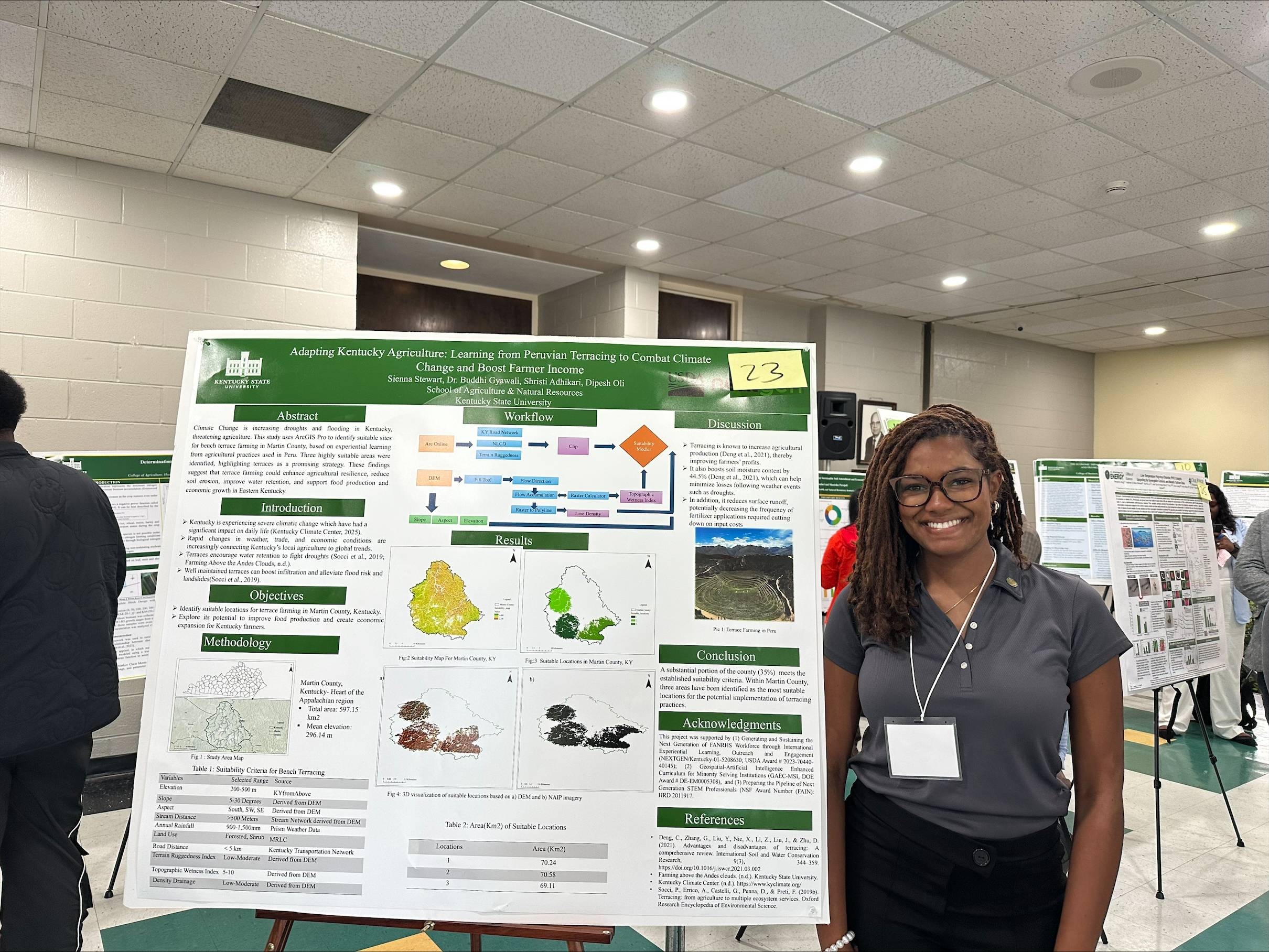
Her project, “Adapting Kentucky Agriculture: Learning from Peruvian Terracing to Combat
Climate Change and Boost Farmer Income,” uses ArcGIS Pro to identify suitable sites
for bench terrace farming in Martin County, Kentucky.
 Stewart’s research grew from Kentucky State’s USDA NextGen-supported experiential
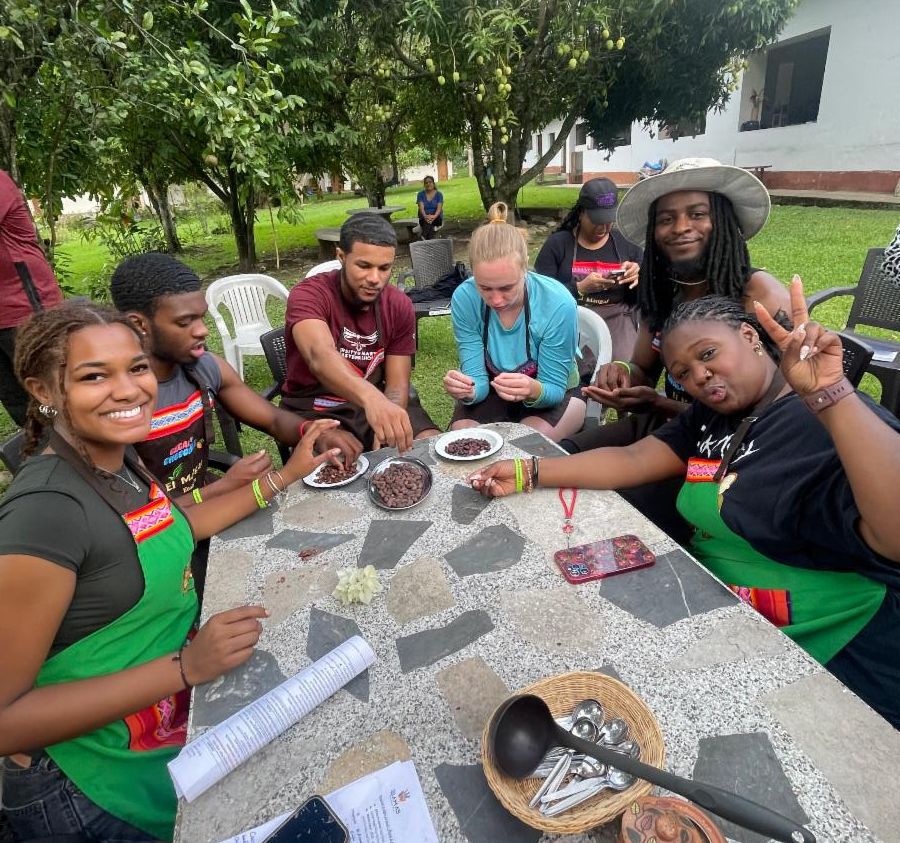
learning program in Peru, where 11 students took part in an 11-day visit from Dec.
13-23, 2025. The program introduced students to agriculture, sustainability, food
systems, trade, and climate adaptation across Lima, Cusco, Ollantaytambo, the Sacred
Valley, and rural agricultural communities.
Stewart’s research grew from Kentucky State’s USDA NextGen-supported experiential
learning program in Peru, where 11 students took part in an 11-day visit from Dec.
13-23, 2025. The program introduced students to agriculture, sustainability, food
systems, trade, and climate adaptation across Lima, Cusco, Ollantaytambo, the Sacred
Valley, and rural agricultural communities.
The experience exposed students to terraced agricultural landscapes at sites including
Machu Picchu and Moray, where Inca agricultural design showed how slope, soil, water,
and microclimates can be managed for resilient food production. For Stewart, that
experience became the starting point for research connecting two mountainous agricultural
regions: the Andes and Appalachia.
“Seeing terrace farming in Peru changed the way I think about agriculture in mountainous
regions,” Stewart said. “The Andes showed me how farmers can use the land’s natural
shape to manage water, protect soil, and support food production. When I returned
to Kentucky, I wanted to explore whether those same principles could help farmers
in Eastern Kentucky adapt to drought, flooding, and erosion.”
Using geospatial analysis, Stewart examined elevation, slope, aspect, stream distance,
annual rainfall, land use, road access, terrain ruggedness, topographic wetness, and
drainage density to assess where bench terracing may be most suitable in Martin County.
Her analysis identified three highly suitable areas, each measuring about 69 to 71
square kilometers, and found that approximately 35% of the county meets the project’s
suitability criteria.
The project suggests terrace farming could offer multiple benefits for Eastern Kentucky
agriculture, including reduced soil erosion, improved water retention, increased agricultural
resilience, expanded food production, and potential economic growth for farmers.
Stewart presented the work during Kentucky State’s Annual Research Day on April 30.
 In a March reflection, “Farming Above the Andes Clouds”, Dr. Maheteme Gebremedhin, chair of the School of Agriculture and Natural Resources,
described terraced hillsides, stone walls, and guided water channels as examples of
deliberate agricultural design meant to hold soil in place, slow runoff, and protect
fragile ground from erosion. He wrote that the Andes helped students see “the land
itself” as a living textbook, connecting classroom concepts to field realities.
In a March reflection, “Farming Above the Andes Clouds”, Dr. Maheteme Gebremedhin, chair of the School of Agriculture and Natural Resources,
described terraced hillsides, stone walls, and guided water channels as examples of
deliberate agricultural design meant to hold soil in place, slow runoff, and protect
fragile ground from erosion. He wrote that the Andes helped students see “the land
itself” as a living textbook, connecting classroom concepts to field realities.
Stewart’s project extends that lesson into applied research for Kentucky. By pairing
international field experience with geospatial tools, her work explores how traditional
agricultural practices may inform modern climate adaptation strategies in rural communities
facing steep terrain and shifting weather patterns.
“Sienna’s work is an excellent example of what we hope international experiential
learning will produce,” said Dr. Buddhi Gyawali, professor of geospatial applications,
human dimensions, and climate studies. “She connected what she observed in Peru with
a real challenge facing Kentucky communities, then used geospatial science to ask
where solutions might be possible. We are very proud of her.”
Stewart’s project was supported by Kentucky State research and training initiatives,
including the USDA NextGen project, the U.S. Department of Energy-supported Geospatial-Artificial
Intelligence Enhanced Curriculum for Minority Serving Institutions project, and the
National Science Foundation-supported Preparing the Pipeline of Next Generation STEM
Professionals project.
The fellowship marks another example of Kentucky State students turning applied research,
international learning, and land-grant inquiry into work that serves the Commonwealth.
For Stewart, the project connects global learning with local purpose, using lessons
from Peru to explore new possibilities for resilience, food production, and the future
of farming in Eastern Kentucky.