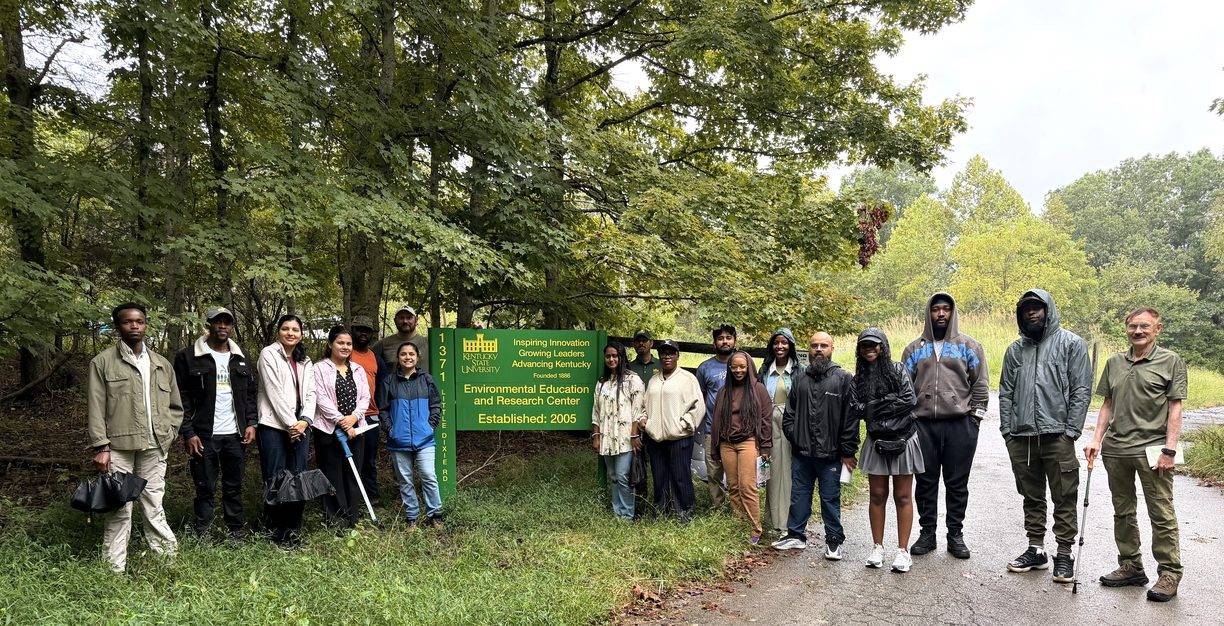
Dr. Manisha Parajuli leads field lessons in forest inventory, plant identification, and invasive plant management
FRANKFORT, Ky. — A tree’s diameter and height can tell researchers much more than its size. During a field visit Friday, Sept. 11, 2026, to Kentucky State University’s Environmental Education and Research Center, graduate students measured both and learned how the results can be used to estimate standing tree volume, biomass, and carbon.
Dr. Manisha Parajuli, assistant professor of forestry, led the visit for students in her Fundamentals of Environmental Science (ENV 501) course. Across the center’s wooded landscape, they put classroom lessons to work through tree measurement, plant identification, and conversations with staff who help manage the site.
The Environmental Education and Research Center spans 308 acres in Henry County, near Pleasureville. Its 1.6-acre pond, 6.5 miles of walking trails, and field sites support learning in anthropology, aquatic sciences, forestry, biology, and science education. The center also serves schoolchildren, community groups, educators, and researchers, giving Kentucky State an expansive outdoor setting for teaching, research, and environmental education.
One of the students’ main activities introduced them to forest inventory: gathering measurements that help describe and assess forest resources. They practiced using a Biltmore stick, calipers, and a range finder to determine diameter at breast height and tree height. Those measurements provide a starting point for estimating standing tree volume, biomass, and carbon and for making informed management decisions.
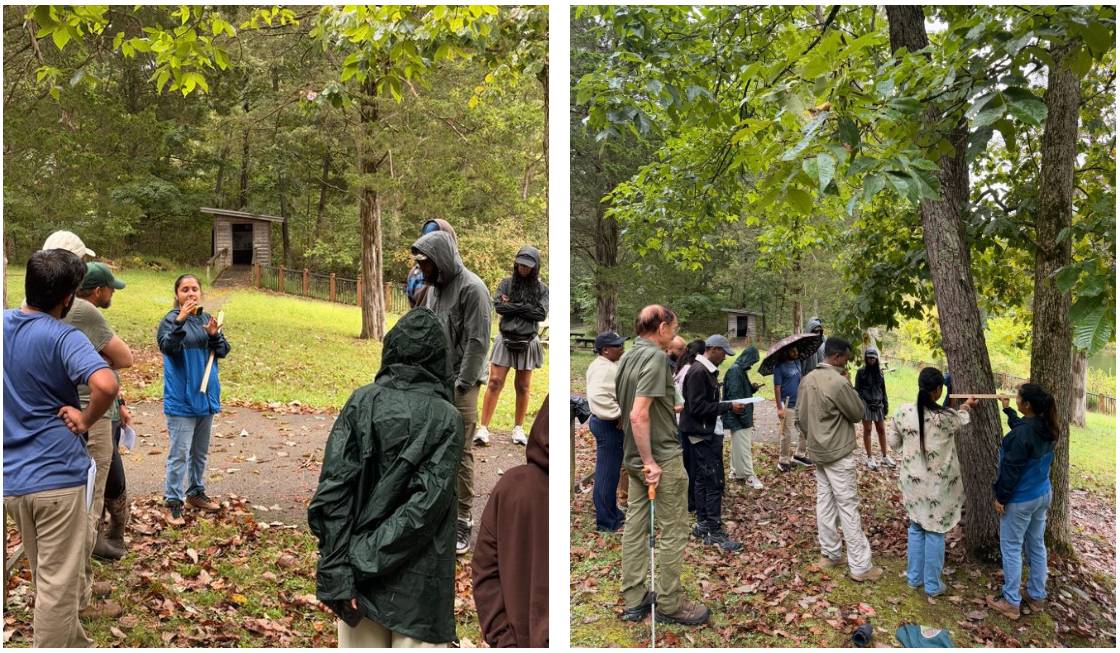
“The EERC is a living laboratory for hands-on learning,” Dr. Parajuli said. “Students measure trees, identify plants where they grow, and see how their observations help us understand and manage forest resources.”
The class also examined native and invasive plants growing at the center. Students identified sugar maple, black maple, wild garlic, white snakeroot, and witch grass, among other species. Seeing autumn olive and Japanese stiltgrass in the field helped them understand how invasive plants can affect forest ecosystems and why identifying them matters to management efforts.
Switchgrass opened another line of discussion. Students considered its potential use as a biomass source for biofuel production, connecting a plant they could observe at the site with a possible application in renewable energy.
Extension assistants Lynn Garrison and Ian Ries guided the group through the areas visited and shared their knowledge of the center’s vegetation and forest resources. Their explanations added practical context to the students’ observations and introduced them to the work involved in studying and managing a natural area.
By the end of the visit, concepts from ENV 501 had become measurements taken in the woods, species recognized where they grow, and questions students could examine firsthand. The habits behind that work—careful observation, reliable measurement, and applying evidence to decisions—will serve them well beyond the course.